
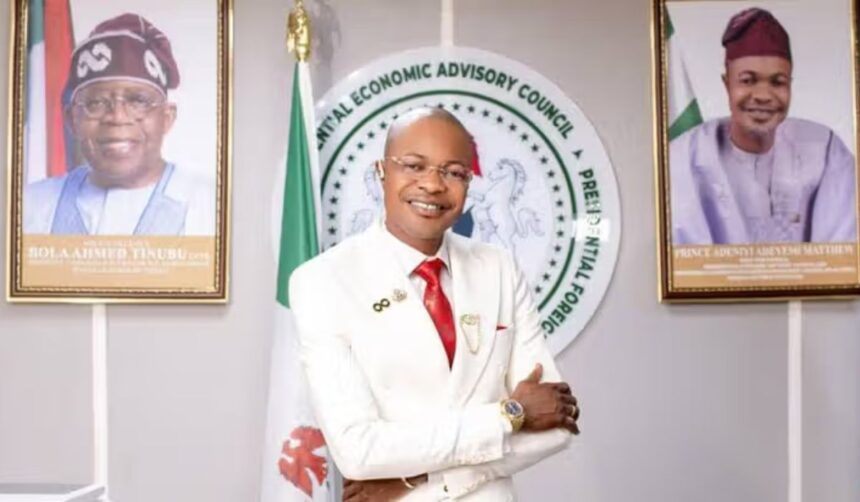
The Managing Director of Divine Dopacy Nigeria Limited, Gbenga Collins, has told the House of Representatives ad hoc committee investigating the Presidential Foreign Intervention Promotion Council (PFIPC) controversy that he paid ₦400 million to Adeniyi Adeyemi to facilitate the award of a government contract.
Collins made the disclosure while testifying before the committee probing alleged irregularities surrounding the PFIPC and the ₦1.3 billion appropriated to the council in the 2026 Appropriation Act.
RELATED NEWS:PFIPC Probe: Reps Committee Declares Alleged PFIPC DG’s Appointment Letter Fake
PFIPC Probe: Head of Service Admits Lack of Due Diligence in Recruitment Approvals
He told lawmakers that he believed the PFIPC was a legitimate federal government agency because Adeyemi operated from an office within the Federal Secretariat in Abuja, used official vehicles with government number plates and was accompanied by security personnel.
According to Collins, he first met Adeyemi in December 2024, when he introduced himself as the Director-General of the PFIPC and the Presidential Economic Advisory Council (PEAC).
He said Adeyemi later informed him of plans to renovate and furnish what he described as his official residence and invited his company to execute the project.
Collins testified that Adeyemi personally took him to inspect the property alongside members of his staff and security personnel before presenting him with a contract award letter, scope of work and refurbishment agreement in April 2025.
The businessman said Adeyemi subsequently requested ₦400 million to demonstrate his company’s financial capacity and facilitate mobilisation for the project.
“I had to pay ₦400 million for the facilitation of that project to show my strength that I would be able to handle the project,” Collins told the committee.
He explained that the funds were sourced from business associates who trusted him because he believed he was dealing with a genuine government institution after visiting Adeyemi’s office.
Collins said the money was paid in five instalments between May and July 2025 into accounts belonging to World Entrepreneurs Limited and Sunshine Confectionery and Catering Services.
However, he said the promised mobilisation funds were never released despite repeated assurances that payment would begin in August and later November 2025.
“My lawyer was the first person who told me that I had been scammed,” Collins said.
He added that he subsequently petitioned the Economic and Financial Crimes Commission (EFCC).
Although he admitted he did not comply with the Public Procurement Act, Collins denied paying a bribe, insisting he believed the payment was a legitimate requirement for facilitating the contract.
He appealed to the lawmakers to help recover the ₦400 million from Adeyemi.
The PFIPC controversy has also implicated the Chief of Staff to the President, Femi Gbajabiamila, after Adeyemi claimed the presidential aide issued his appointment letter as Director-General, an allegation Gbajabiamila has strongly denied.
Adeyemi had also claimed he borrowed ₦400 million to secure the appointment and that the lenders later reported him to the EFCC after he failed to repay the debt.
Police arrested Adeyemi in Osun State on July 14, days after Gbajabiamila filed a ₦15 billion defamation suit against him.
The controversy has continued to deepen, with several heads of government agencies alleging that forged documents submitted by Adeyemi paved the way for budgetary allocations to the PFIPC.
Further testimonies before the House committee by the Accountant-General of the Federation and the Head of the Civil Service of the Federation also raised concerns over document verification failures and the approval process that allowed the agency’s staffing structure and recruitment waiver to proceed.