
Global oil prices climbed above $100 per barrel on Monday while stock markets fluctuated as the war between Iran and Israel entered its third week, raising concerns over global energy supply and economic stability.
Crude prices jumped shortly after Donald Trump said over the weekend that United States forces had struck military targets on Kharg Island, a key Iranian oil export hub in the Gulf that handles most of the country’s crude shipments.
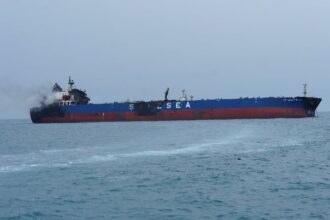
Trump also warned that further attacks could extend to energy infrastructure if Iran interferes with shipping through the vital Strait of Hormuz, which has effectively been closed since joint US-Israeli operations began on February 28.
Iran’s Fars News Agency later reported that no oil infrastructure on the island was damaged in the strikes.
Trump urged major economies to deploy warships to keep the strategic waterway open, saying countries that rely on oil shipments through Hormuz should help secure the route.
“The countries of the world that receive oil through the Hormuz Strait must take care of that passage, and we will help a lot,” Trump wrote on his Truth Social platform.
However, Japan said it was not currently considering a maritime security mission, while Australia announced it would not send naval vessels to the region.
Iran’s Foreign Minister Abbas Araghchi said Tehran was not interested in negotiations with the United States.
“We don’t see any reason why we should talk with Americans, because we were talking with them when they decided to attack us,” he told CBS News in an interview on Face The Nation.
He added that Iran had not requested a ceasefire or negotiations, though it was open to discussions with countries seeking safe passage for their vessels through Hormuz.
The conflict continued on Monday with new exchanges of fire across the region.
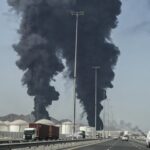
Saudi Arabia said it intercepted more than 60 drones overnight, while flights were temporarily suspended at Dubai International Airport in the Dubai after a drone-related incident sparked a nearby fire.
Araghchi also condemned Israeli strikes on fuel depots in Tehran, describing them as “ecocide” due to the potential long-term environmental and health risks.
Oil markets reacted sharply to the escalating conflict; Brent crude surged about 3% to $106.50 before settling near $104, West Texas Intermediate traded just above $99 per barrel
In response to the surge in prices, Japan said it had begun releasing oil from its strategic reserves after the International Energy Agency (IEA) indicated that member states would start releasing stockpiles.
IEA countries last week agreed to release 400 million barrels of oil, a record intervention aimed at stabilising energy markets.
With fears of an energy crisis growing, stock markets showed mixed performances across Asia.
Markets in Tokyo, Shanghai, Sydney, Wellington, Taipei, Manila and Jakarta fell, while Hong Kong, Seoul, Singapore, Mumbai and Bangkok posted gains.
Analysts say the key factor for markets will be the reopening of shipping routes through the Strait of Hormuz.
“The longer the Strait is impassable, the tighter commodity supply will become, thus the higher prices will likely go,” said market strategist Michael Brown of Pepperstone.
Investors are also closely watching upcoming policy meetings at major central banks, including the Federal Reserve, Bank of England, and European Central Bank.
Although the banks are widely expected to keep interest rates unchanged, any comments about the economic impact of the war could influence global markets in the coming weeks.