
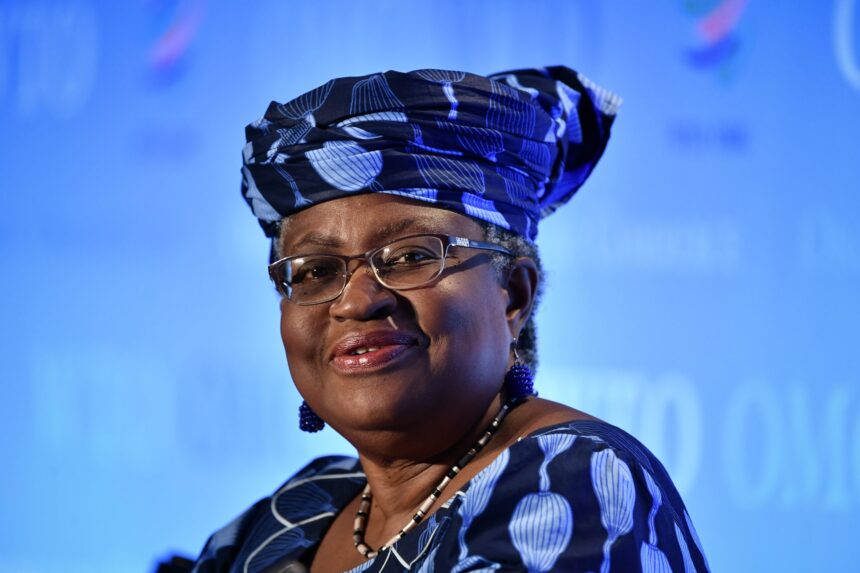
Director-General of the World Trade Organisation (WTO), Dr. Ngozi Okonjo-Iweala, has said Nigeria must overcome its deep-rooted ethnic, religious and regional divisions to achieve sustainable development and long-term prosperity.
Speaking on Thursday in Abuja at the public presentation of The Pain and the Promise: Insights and Fragments on Nigeria and People, Public and Personal (1990–2026), a new book by communications strategist and public policy analyst Paul C. Nwabuikwu, the former Minister of Finance warned that the country would continue to struggle to make meaningful progress without a shared national vision.
“Until Nigerians can overcome the ethnic, religious, and regional divides embedded in our society to forge a social compact that agrees on key directions for the nation, Nigeria will find it difficult to move forward at the pace required to create enduring prosperity for our people,” she said.
Okonjo-Iweala also urged Nigerians to prioritise competence over ethnicity and regional considerations in public appointments and leadership.
“I believe in talent from every corner of Nigeria. There’s no place in Nigeria that doesn’t have talented people. I don’t care what part of the country you come from. I just wanted you to do your job and do it professionally,” she said.
The WTO chief reflected on Nigeria’s landmark Paris Club debt relief secured during the administration of former President Olusegun Obasanjo, revealing that effective communication played a crucial role in the success of the country’s economic reform programme.
She recalled returning from the World Bank in 2003 to strengthen Nigeria’s finances and negotiate the cancellation of nearly $30 billion owed to the Paris Club of creditors.
According to her, the far-reaching reforms required public understanding and support, making strategic communication a vital component of the process.
She explained that this informed her decision to bring Nwabuikwu into the economic management team to lead public communications.
“To do this work, I knew Nigeria would have to undertake serious economic reforms of the type that would demand understanding and sacrifices from Nigerians.
“One important component in my mind then was that we would need a crack communications person or team to help us reach Nigerians, to explain all of this in simple language. That is where Paul came in,” she said.
Describing the author as “smart, articulate, compassionate, a terrific writer and communicator,” Okonjo-Iweala credited him with helping the government build public confidence throughout the reform process.
“I can say without fear of contradiction that we wouldn’t have had as much success with the reform programme if we had not had a masterful steering of communications from Paul,” she added.
She stressed that successful reforms in a democracy require more than policy formulation, noting that governments must also earn public trust.
“Reform is not just about writing new laws and enforcing new policies. It’s about persuading people, explaining trade-offs, and building enough trust that governments can keep pushing through obstacles,” she said.
Reviewing the 300-page book, Okonjo-Iweala described The Pain and the Promise as a significant contribution to Nigeria’s intellectual and public policy discourse, saying it chronicles the country’s political, economic and social evolution over the past three decades.
She praised the work for blending public commentary with personal reflections to present what she described as “a portrait of a generation in the life of what I insist is the most interesting, if chaotic, country in the world.”
She recommended the book, particularly to young Nigerians seeking a deeper understanding of the country’s history, governance and development.
Former Minister of Aviation and Chairman of the Athena Centre, Osita Chidoka, also described the book as an important contribution to Nigeria’s national conversation.
“There is pain, and I must say we all know that much of it is self-inflicted and not necessarily prolonged, but there is also promise in our people, in our creativity, and in the possibility of that thoughtful engagement,” Chidoka said.
Vice-Chancellor of Baze University, Prof. Abiodun Adeniyi, who also reviewed the book, described it as “a chronicle of Nigeria’s contemporary experience” and “an archive of conscience,” saying it goes beyond a collection of newspaper articles to become a documentary record of the nation’s political and social journey.
Nigeria secured a landmark Paris Club debt relief deal in 2005, with creditors writing off about $18 billion—roughly 60 per cent of the country’s estimated $30 billion bilateral debt. The agreement, concluded under the Obasanjo administration, was fully implemented on April 21, 2006.