

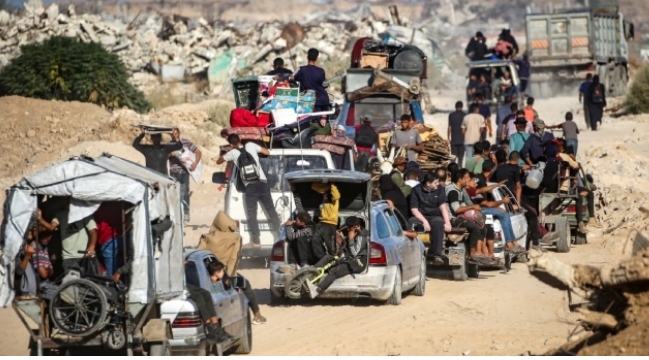
Thousands of displaced Palestinians flooded back into Gaza City on Saturday, the second day of a fragile ceasefire between Israel and Hamas, finding their homes reduced to rubble after weeks of relentless bombardment.
The truce, brokered under a deal proposed by U.S. President Donald Trump, prompted Israel to pull back troops from several parts of the enclave on Friday, allowing long convoys of exhausted residents to make their way north along the coastal road.
Among them was Raja Salmi, who trekked for hours to her home in Gaza’s Al-Rimal neighbourhood — only to find it gone.
“It no longer exists. It’s just a pile of rubble,” she told AFP. “I stood before it and cried. All those memories are now just dust.”
According to Gaza’s civil defence agency, about 50,000 people returned to Gaza City on Saturday, bringing the total number of returnees since the start of the ceasefire to roughly 250,000.
Under the U.S.-backed agreement, Hamas is expected to hand over 47 remaining hostages — both living and dead — from the 251 abducted during its October 7 attack on Israel two years ago. The remains of another hostage, held since 2014, are also to be returned.
In exchange, Israel will release 250 prisoners serving life sentences and 1,700 Palestinians detained since the war began. The list, however, excludes senior militant figures sought by Hamas.
The 72-hour truce, which began at 0900 GMT on Friday, requires Hamas to complete the hostage releases by Monday morning.
Hamas and allied factions — including Islamic Jihad and the Popular Front for the Liberation of Palestine (PFLP) — described the ceasefire as “a setback” for Israel’s efforts to uproot Gaza’s population, pledging continued cooperation with mediators to “protect the rights of our people.”
President Trump expressed optimism that the ceasefire would hold, saying both sides were “tired of the fighting.” He confirmed plans to visit Israel and Egypt this weekend to push for further dialogue.
Still, key aspects of the Trump plan remain unresolved, including who will govern Gaza after the war and the demand for Hamas to disarm — conditions the group has resisted.
In Gaza City, scenes of devastation remained overwhelming. At Al-Rantisi hospital, once a vital centre for children and cancer patients, wards lay in ruins with collapsed ceilings and overturned beds.
“I don’t know what to say,” said resident Saher Abu Al-Atta. “The images speak louder than any words: destruction, destruction, and more destruction.”
As the United Nations recently declared famine in the city, aid groups are racing to use the truce to deliver relief. The UN Office for Humanitarian Affairs (OCHA) said Israel had approved 170,000 tonnes of supplies for the first 60 days of the ceasefire.
“The most basic necessities are still urgently needed — medical supplies, food, water, fuel, and shelter for two million people facing winter without roofs over their heads,” said Jacob Granger, Gaza coordinator for Doctors Without Borders (MSF).
The truce offers a brief respite — but for many in Gaza, the return home has brought heartbreak and uncertainty, not peace.