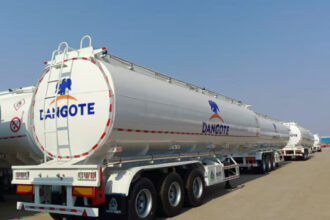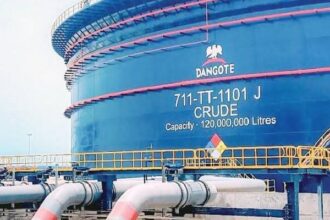

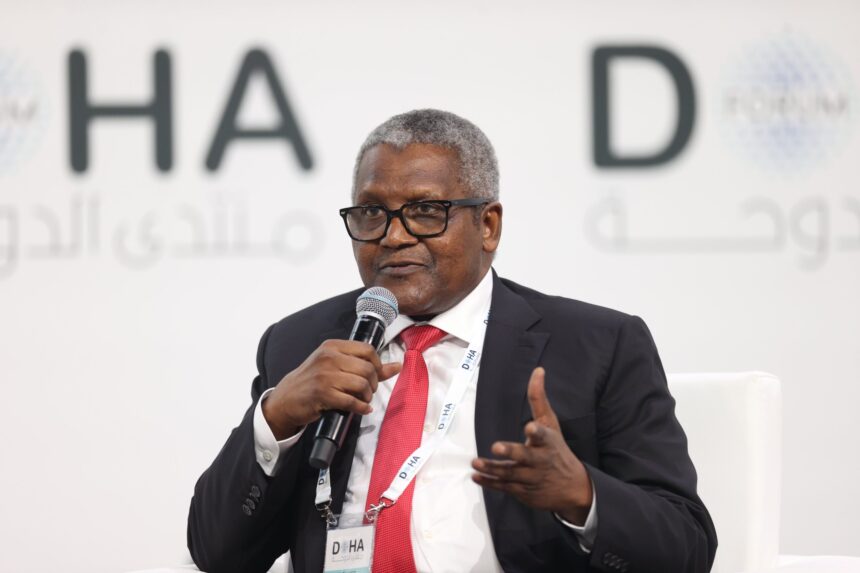
President of the Dangote Group, Aliko Dangote, has disclosed that the company rejected attempts by the Nigerian National Petroleum Company Limited to increase its stake in the Dangote Petroleum Refinery ahead of plans for a public share offering.
Dangote made the disclosure on Wednesday during an interview with Nicolai Tangen.
According to the billionaire businessman, the decision was taken to allow broader public participation in the refinery through a future initial public offering (IPO).
“The other biggest risk is government inconsistencies in policies, and we are addressing that one because if you look at our refinery, the national oil company already owns 7.25 per cent, and they are trying to buy more. We are the ones that said no; we want to now spread it and have everybody be part of it,” Dangote said.
The NNPC had acquired a 7.25 per cent stake in the refinery in 2021 for $1 billion, with an option to purchase an additional 12.75 per cent stake by June 2024.
Dangote recalled that the original agreement gave the NNPC a planned 20 per cent stake in the refinery, but the company failed to complete payment for the remaining shares.
“The agreement was actually 20 per cent, which we had with NNPC, and they did not pay the balance of the money up until last year; then we gave them another extension up until June (2024), and they said that they would remain where they had already paid, which is 7.2 per cent. So NNPC owns only 7.2 per cent, not 20 per cent,” he stated in 2024.
Former NNPC Group Chief Executive Officer Mele Kyari had overseen the reduction of the company’s stake from the initially proposed 20 per cent.
Defending the decision at the time, former NNPC spokesperson Olufemi Soneye said the state oil company redirected funds toward investments in compressed natural gas infrastructure.
Dangote also identified policy inconsistency and insecurity as major risks facing the refinery project.
He revealed that the refinery currently processes about 661,000 barrels of crude oil per day, exceeding its official 650,000 barrels-per-day nameplate capacity.
“The refinery has been tested. We have now processed even crude at 661,000 barrels a day. So we have demonstrated that capability. Now, a lot of financial institutions are saying that, ‘Yes, if it is you doing this project, we are there to back you because we know that you can deliver; you have the capacity, you have the knowledge, and you have the experience,” he said.
The industrialist explained that several financial institutions supported the refinery project after naira devaluation disrupted the company’s original funding strategy.
According to him, institutions including African Export-Import Bank, Africa Finance Corporation, Zenith Bank, Access Bank, United Bank for Africa, Standard Bank and Standard Chartered provided funding support for the project.
Speaking on the impact of the Middle East conflict on his businesses, Dangote said rising global demand and prices for fuel and fertiliser had positively affected operations.
“The effect of the war on our businesses is more beneficial than a downside because today, fertiliser is in very high demand. In February, before the Middle East crisis, urea was selling for about $400 a tonne. Today we are selling a tonne of fertiliser for $850, and we are actually oversold,” he said.
He also disclosed that polypropylene prices surged from about $900 to nearly $3,000 in the United Kingdom, adding that local plastic manufacturers in Nigeria would have struggled without domestic production from his company.
“Our aviation fuel is oversold till the middle of July, and we’re producing 20 million litres of jet fuel a day,” Dangote added.
On crude supply, Dangote said the refinery sources about 56 per cent of its crude from Nigeria, while additional supplies come from Angola, Libya and the United States.
“We have to now buy 21 cargoes every month. That’s how big we are. And we’re more than doubling the refinery. You know, in the next 30 months, we will be at 1.4 million barrels per day, which is huge,” he stated.
Dangote further alleged that entrenched interests benefiting from Nigeria’s former fuel subsidy regime attempted to frustrate the refinery project.
“The Mafia are the people who are actually benefiting because Nigeria was giving out almost $10bn every year as a subsidy. There are shippers who are making tonnes of money. There are traders who are making a lot of money buying crude and sending us refined products,” he said.
He revealed that the company plans to inject approximately $45 billion into its businesses, with a long-term target of generating $100 billion in revenue by 2030.
Dangote also spoke about his personal sacrifices in pursuing industrialisation, revealing that he sold luxury properties in the United States and the United Kingdom to focus fully on his investments in Nigeria.
“When I decided to go into the industry, you know what I did? I sold all my properties in the US. I had two houses in the US, big mansions, and I had a house in the UK. I wanted to really sit in Nigeria and concentrate,” he said.
He added that the Dangote Group’s business strategy focuses on local production and reducing import dependence through backward integration.
“I first of all look at what we need as a people? What is it that we are supposed to be producing, and we’re importing? So we do what you call ‘backward integration’,” Dangote stated.