
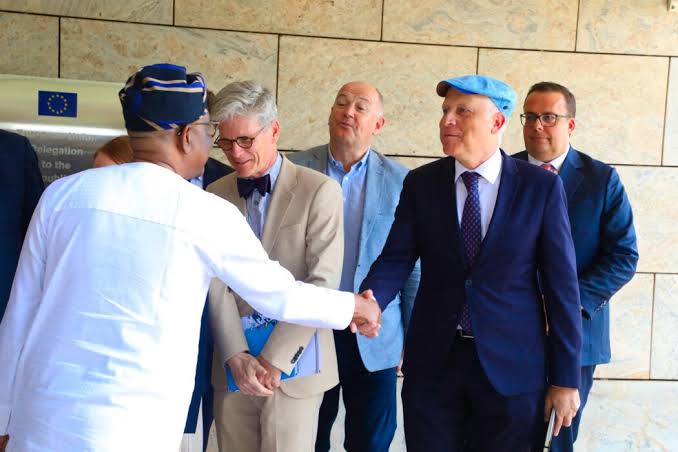
Minister of the Federal Capital Territory (FCT), Nyesom Ezenwo Wike, has called on European Union (EU) member states to strengthen investment partnerships, expand cultural exchanges, and collaborate with the Federal Capital Territory Administration (FCTA) to drive development in Abuja and Nigeria.
Wike made the appeal on Tuesday while addressing EU Heads of Mission at the European Union House in Abuja, where he reaffirmed his commitment to sustained engagement with European partners.
The meeting was chaired by Gautier Mignot, Head of the European Union Delegation to Nigeria and the Economic Community of West African States (ECOWAS), and was attended by envoys from multiple EU countries including Italy, Austria, Ireland, France, Germany, Spain, and others.
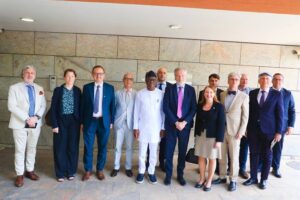
In his opening remarks, Mignot described the European Union as Nigeria’s foremost trade and investment partner, setting the tone for discussions on deepening bilateral cooperation.
Addressing the diplomats, Wike outlined key priorities of the FCTA, highlighting Abuja’s potential as a business-friendly capital city with diverse investment opportunities. He identified sectors such as real estate and housing, tourism and entertainment, agriculture, solid minerals, and waste management as areas open for increased foreign participation.
“I thank the European Union Delegation to Nigeria for the invitation and continued partnership with the Nigerian Government in advancing shared values of development, stability, and prosperity.
“Today, drawing from the Renewed Hope Agenda of Mr. President, His Excellency Bola Ahmed Tinubu, GCFR, I will briefly highlight the priority areas of the Federal Capital Territory Administration (FCTA), the investment opportunities therein, and offer an overview on Nigeria’s evolving political landscape,” Wike said.
The minister emphasised that the FCTA is prioritising infrastructure expansion, security enhancement, education, healthcare, social welfare, land administration reforms, and revenue generation.
“We have embarked on a deliberate and sustained investment in infrastructure as a catalyst for economic growth and social inclusion by expanding road networks, modernizing public transport and improving water supply.
“As a priority too, the administration has strengthened security infrastructure through the building of 12 new fully equipped/furnished Divisional Police Headquarters and Officers’ Quarters, (2 each in the 6 Area Councils).”
Speaking on governance reforms, Wike highlighted provisions in the amended Electoral Act, noting improvements aimed at strengthening electoral credibility while accommodating Nigeria’s unique challenges.
“In the newly ammended Electoral Act, there is provision for electronic transmission of results. But because of our peculiarities, it was included that where electronic transmission fails, manual transmission can be used. Meanwhile, there is no such provision in the 2022 ammended Electoral Act,” he said.
He also underscored the importance of constructive opposition in a developing democracy, stating that dissent should focus on providing alternatives rather than fostering instability.
On the broader political landscape, Wike said Nigeria is gradually shifting toward governance driven by competence rather than ethnicity or partisan considerations, adding that relations between the executive and legislative arms have improved.
“Compared to earlier periods, there is a decline in highly volatile and rancorous politicking that characterized the relationship between the Executive and the Legislature. The relationship between these two key institutions have become that of ‘partners-in-progress’ in the making and implementation of policies and programmes for the welfare of Nigerians,” he said.
Highlighting the policy direction of President Bola Ahmed Tinubu, Wike pointed to ongoing economic and structural reforms under the Renewed Hope Agenda, including subsidy removal, foreign exchange unification, and tax system reforms.
“The Current Administration in its Renewed Hope Agenda framework, has made bold and at times, difficult reforms aimed at repositioning the economy and improving citizens’ welfare.
“These include; Economic Reforms and Fiscal Restructuring/Discipline, which ensured Subsidy Removal to eliminating a long-standing but corruption-prone system and free up public funds, unification of foreign exchange rates to stabilize the currency and tax reforms aimed at Streamlining the Tax System to improve revenue generation.”
He added that social intervention programmes, including conditional cash transfers, support for small businesses, and student loan schemes, are being implemented to cushion the impact of reforms on vulnerable groups.
Addressing security concerns, Wike acknowledged ongoing challenges such as insurgency, banditry, and communal conflicts, partly linked to instability in the Sahel region. He, however, assured that efforts are underway to strengthen security architecture, improve inter-agency coordination, and enhance intelligence capabilities.
The meeting reflects ongoing diplomatic engagement between Nigeria and the European Union, with both sides seeking to deepen cooperation across economic, political, and developmental fronts.