
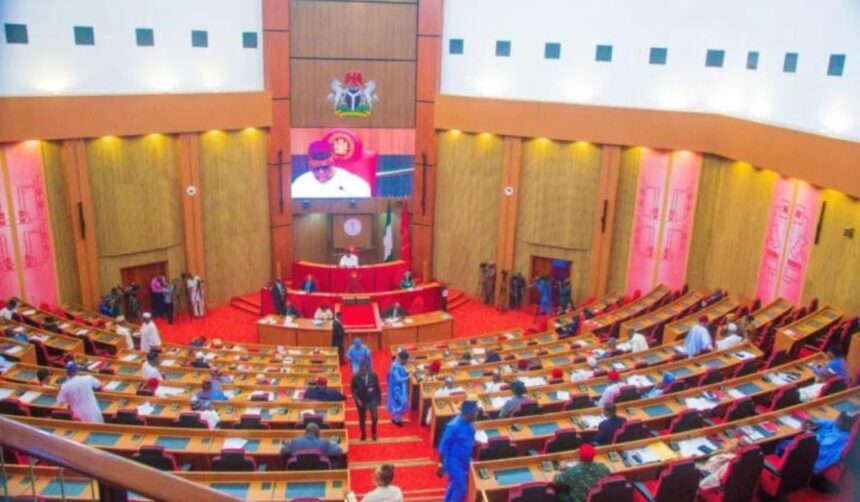
The leadership of the Nigerian Senate is set to hold a high-level meeting with officials of the International Monetary Fund (IMF) to discuss Nigeria’s economic outlook and ongoing reform programmes under the administration of Bola Tinubu.
The engagement forms part of the IMF’s Article IV Consultation with Nigeria, a routine assessment of a member country’s economic policies and financial stability.
The consultation exercise, which runs from March 4 to March 17, 2026, will involve meetings between the IMF team and key government institutions.
The planned interaction with lawmakers is expected to provide members of the Senate with deeper insights into the government’s economic management framework and explore possible support the global financial institution could offer for the Federal Government’s reform agenda.
The development was disclosed by the Deputy President of the Senate, Barau Jibrin, who noted that the IMF specifically requested a high-level engagement with the Senate leadership as part of the consultation process.
According to a notice to lawmakers, the meeting will serve as a platform for dialogue between the legislative arm and IMF officials on Nigeria’s economic direction and reform strategies.
Economic Growth Outlook
Nigeria’s economic outlook for 2025 has been described by global financial institutions as cautiously improving but still fragile.
The IMF projects that Nigeria’s economy will grow by about 3.4 per cent in 2025, reflecting a modest recovery driven largely by increased activity in non-oil sectors.
Similarly, the World Bank expects Nigeria’s economy to grow by around 3.6 per cent between 2025 and 2026, noting that reforms such as fuel subsidy removal, exchange-rate unification, and tighter monetary policy are gradually improving investor confidence and stabilising government finances.
Despite the improvements, analysts say the outlook remains constrained by persistent inflation, fiscal pressures, and structural challenges such as energy supply shortages and infrastructure gaps.
Stronger Growth Expected In 2026
Looking ahead, global institutions are more optimistic about Nigeria’s medium-term prospects.
The IMF has revised Nigeria’s growth forecast upward to about 4.4 per cent in 2026, while the World Bank also projects economic expansion of roughly 4.4 per cent in both 2026 and 2027.
The anticipated growth is expected to be driven by the services sector — particularly telecommunications and financial services — as well as agriculture and other non-oil industries, as Nigeria continues efforts to diversify its economy.