
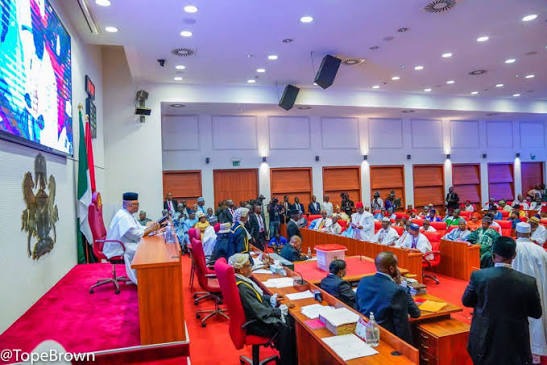
The Senate on Wednesday approved far-reaching resolutions to tackle Nigeria’s worsening insecurity, formally designating kidnapping as an act of terrorism and endorsing the death penalty for convicted kidnappers, with no option of fines or judicial discretion.
The heated session followed the November 18 attack on Christ Apostolic Church, Eruku, in Ekiti Local Government Area of Kwara State, where gunmen killed two worshippers and abducted 38 others. All victims were later rescued through a coordinated operation involving security agencies and local vigilantes, but lawmakers said the incident exposed expanding insurgent networks and the steady collapse of security in rural communities.
The debate was triggered by a motion from Senator Yisa Ashiru (Kwara South) titled “Urgent Need to Address Escalating Insecurity in Kwara, Kebbi, and Niger States and Strengthen National Security Frameworks.”* His presentation opened a tense discussion on attacks targeting schools, churches, highways and entire settlements.
Lawmakers warned that continuous school abductions had forced widespread shutdowns, affecting all schools in several LGAs in Kebbi and Niger, five LGAs in Kwara, and all 47 Federal Unity Colleges. Senator Issa Jibrin (Kogi East) lamented severe manpower shortages, noting that Nigeria’s entire security workforce “do not total one million,” far below Egypt’s 1.5 million. He urged immediate upgrades in military hardware, improved intelligence sharing and the creation of a national reserve force.
Other senators raised alarm that bandits were pushing closer to Osun State through the Eruku–Isapa–Koro axis, where a retired Army General and a traditional ruler were recently murdered. They also linked the rising attacks to dilapidated highways, prompting a call on the Ministry of Works to begin emergency repairs on the Idofian–Omu Aran–Eruku–Egbe–Kabba road corridor.
Kidnapping Now Terrorism, Senate Rules
The chamber unanimously ruled that kidnapping has morphed into full-scale terrorism and must attract the harshest possible punishment. Lawmakers insisted:
“Capital punishment must apply,” arguing that judges should not be allowed any discretion to reduce sentences for kidnappers.
The Senate also urged President Bola Tinubu to further strengthen the nation’s security architecture. Senator Ali Ndume, however, cautioned that the wording could be misinterpreted due to the recent confirmation of service chiefs, leading the Senate to clarify that it was calling for improved coordination, intelligence and rapid-response capabilities.
Senate Dissolves Key Security Committees
In what senators described as an unprecedented self-evaluation, the chamber dissolved the Committee on National Security and Intelligence as well as the Committee on Air Force. All remaining security-related committees were directed to submit written oversight reports and brief the Senate behind closed doors within one week.
Lawmakers further called for stronger support to registered vigilante groups and ordered a review of the firearms law to allow controlled arming of qualified citizens.
Earlier, the Senate approved a related motion commending the President and security agencies for recent rescue operations in Kwara and Niger, while urging the creation of a Joint Task Force along the Kwara–Kogi axis — a known escape route for bandits.
Debate Intensifies Over Security Failures
During deliberations, senators revisited the Eruku church attack, mass abductions in Kebbi, and the sharp rise in kidnappings across Niger State. Senator Ashiru described the Senate as “deeply disturbed” and referenced credible reports alleging that troops withdrew from a Kebbi school hours before bandits struck.
Deputy Senate President Barau Jibrin argued that Nigeria must expand its global security partnerships, saying:
“We should seek assistance from overseas.”
Senate Leader Opeyemi Bamidele questioned why security agencies had not released details of terrorists neutralised during rescue operations, adding:
“If we are calling on the President to rejig the security architecture, we must also look into our own arrangement.”
Senator Enyinnaya Abaribe rejected attempts to blame previous administrations, insisting that the current government must take responsibility for operational lapses. He said:
“If I were the Commander-in-Chief, I would demand answers.”
Senate President Godswill Akpabio expressed concerns over intelligence leaks, recalling previous incidents where sensitive troop information was compromised. Tensions escalated when Senator Seriake Dickson accused some lawmakers of downplaying the severity of the crisis, saying Nigeria was “losing prestige and integrity,” prompting protests from APC senators.
Senator Adams Oshiomhole later defended the President and demanded a full investigation into the reported troop withdrawal.
“Who ordered the military to withdraw? That person should be tried for terrorism,” he said, a position the Senate adopted. He also pushed for consistent sentencing in terrorism cases while reinforcing the call for the death penalty for kidnappers.