

The Federal Airports Authority of Nigeria (FAAN) has assured travellers and stakeholders that stringent preventive measures have been activated across international airports in response to the Ebola Virus Disease outbreak in parts of Central Africa.
In a statement issued on Wednesday by FAAN’s Director of Public Affairs and Consumer Protection, Henry Agbebire, the authority said it was collaborating closely with Port Health Services, the Nigeria Centre for Disease Control and Prevention (NCDC), and other relevant agencies to strengthen surveillance and passenger monitoring, especially for travellers arriving from high-risk regions.
“Passengers are being screened for symptoms associated with Ebola, and any suspected case will be promptly isolated and subjected to secondary health checks in line with established national and international health protocols,” the statement read.
FAAN also disclosed that it had intensified staff sensitisation, reinforced emergency response procedures, and improved coordination with relevant stakeholders to ensure swift intervention where necessary.
“While there is currently no confirmed case of Ebola in Nigeria, FAAN remains vigilant and fully committed to safeguarding public health and maintaining safe airport operations,” the authority added.
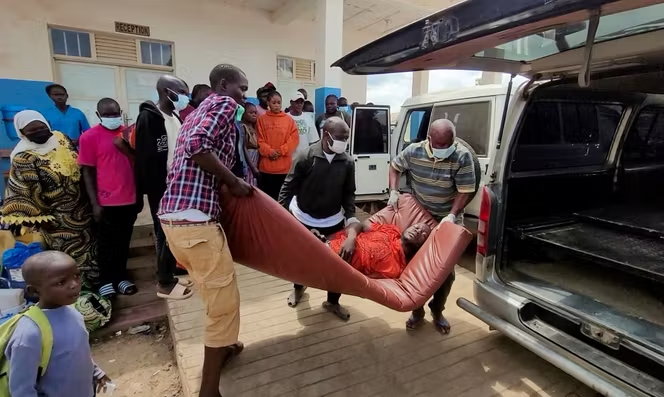
The development follows the declaration by the World Health Organisation (WHO) of the Bundibugyo ebolavirus outbreak in the Democratic Republic of Congo and Uganda as a Public Health Emergency of International Concern on May 17, 2026.
The outbreak, centred in Ituri Province in the DRC, has reportedly spread to Uganda, raising regional concerns following increasing cases and fatalities.
Meanwhile, a consultant in Community Medicine at the University of Uyo Teaching Hospital, Dr Emem Peters, has cautioned Nigerians to remain vigilant over the new Ebola strain known as Bundibugyo.
Speaking during an interview on Channels Television’s *The Morning Brief* on Wednesday, Peters explained that unlike the Zaire strain of Ebola managed during the 2014 outbreak, there are currently no vaccines or specific treatments for the Bundibugyo strain.
“This particular Ebola virus disease outbreak is caused by a different strain called the Bundibugyo strain, different from the one we had in 2014 that was the Zaire strain, and it’s of concern to us,” she said.
“We do not have a vaccine yet to control this, and there are no known treatments for its management. It’s all early detection and supportive care, so it’s a new strain, it’s not the one we had defeated.”
According to reports, the current outbreak in the Democratic Republic of Congo has resulted in 513 suspected cases and 131 deaths.
Peters described Ebola as a viral haemorrhagic disease capable of damaging blood vessels, affecting multiple organs, and causing shock or death in severe cases.
Although Nigeria has not recorded any confirmed case, she urged the public to observe precautionary measures and remain alert to possible symptoms.
“The symptoms one should look out for would include fever, pain, generalized body weakness, headache, vomiting, diarrhea, and in some extreme cases, you could have bleeding; not all cases would come with bleeding,” the doctor explained.