
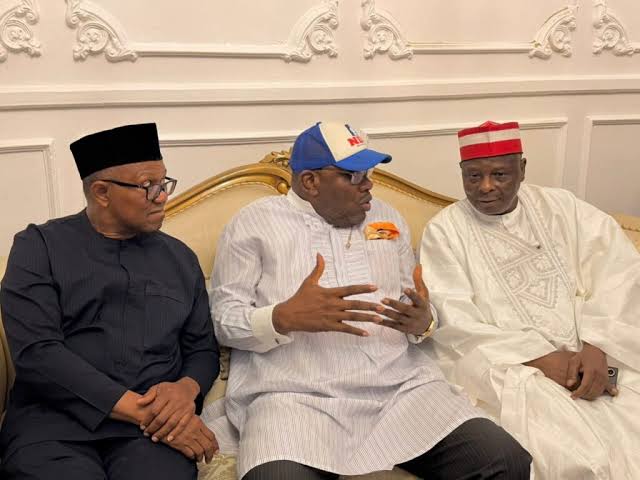
Former Anambra State governor, Peter Obi, and ex-Kano State governor, Rabiu Musa Kwankwaso, have formally joined the Nigeria Democratic Congress (NDC), in a significant political shift ahead of the 2027 general elections.
Obi, the 2023 presidential candidate of the Labour Party (LP), and Kwankwaso, former presidential candidate of the New Nigeria People’s Party (NNPP), were presented with NDC membership cards following a closed-door meeting with party leaders.
They were received into the party by former Bayelsa State governor and NDC national leader, Seriake Dickson, amid cheers from supporters.
The development follows their exit from the African Democratic Congress (ADC), and signals ongoing realignments within opposition ranks.
Addressing party members and supporters, Obi called for unity and urged stakeholders to avoid internal disputes.
“Please, let there be no litigation. Party members, please, don’t go to court. What we want is a party,” he said, stressing the need to focus on governance issues affecting Nigerians rather than internal conflicts.
He also appealed for a free democratic space, devoid of interference, and encouraged Nigerians to join the NDC.
Kwankwaso, in his remarks, urged supporters nationwide to register with the party, stating that his camp had already commenced the process.
Earlier, Dickson described the development as a turning point, expressing confidence that the party would provide a credible alternative platform.
“I welcome you to Nigeria’s fastest-growing political party… a party that has no faction, no litigation whatsoever,” he said, adding that the NDC, though relatively new, is positioned to play a major role in the country’s political future.
Obi had left the Labour Party in December 2025 to join the ADC, aligning with key opposition figures including Atiku Abubakar, Rotimi Amaechi, Rauf Aregbesola, and Nasir El-Rufai.
However, prolonged leadership disputes and court cases within the ADC created deep divisions, prompting Obi’s exit. He said his decision to join the NDC was driven by “deepening internal crises” and the need for a more stable and unified political platform.