
The United States is awaiting Iran’s response to its latest proposal aimed at ending the ongoing Middle East conflict and reopening the strategic Strait of Hormuz.
Global financial markets reacted positively on Thursday after US President Donald Trump signalled that negotiations with Iran were progressing and a potential agreement could soon be reached.
Asian stock markets rallied sharply, while oil prices declined further amid growing optimism over a diplomatic breakthrough.
Brent crude dropped by about two percent, extending losses recorded earlier in the week, while US benchmark West Texas Intermediate also fell below the symbolic $100-per-barrel threshold.
The ongoing war, which began in late February following military action by the United States and Israel, has disrupted regional stability and intensified concerns over global energy supplies.
Iran has responded to the conflict with attacks across the region and restrictions affecting traffic through the Strait of Hormuz, a major global shipping route responsible for transporting nearly one-fifth of the world’s oil and liquefied natural gas exports.
Trump recently launched a naval escort operation intended to secure commercial shipping through the strait, but the initiative was suspended within hours after signs of progress in negotiations mediated by Pakistan and backed by Gulf Arab states.
“We’ve had very good talks over the last 24 hours, and it’s very possible that we’ll make a deal,” Trump told reporters on Wednesday.
He also repeated warnings that military action could resume if Tehran rejects US demands.
Iranian Foreign Ministry spokesman Esmaeil Baqaei confirmed that Tehran is reviewing the latest proposal.
“The US proposal remained ‘under review’ and Tehran would communicate its position to mediator Pakistan ‘after finalising its views’,” he said.
According to reports by NBC News, Saudi Arabia’s refusal to permit the use of its airspace and military bases for the Hormuz naval operation influenced Washington’s decision to pause the mission.
Another report by Axios, citing unnamed officials, claimed that Tehran and Washington are close to finalising a one-page memorandum of understanding designed to halt the conflict and establish a framework for broader talks concerning Iran’s nuclear programme.
Amid the diplomatic efforts, Iran’s internal situation remains tense.
Speaking anonymously from the Iranian city of Tonekabon, a resident identified only as Ali told AFP that conditions inside the country have worsened.
“The economic situation got worse, and this government has become even more brutal,” he said.
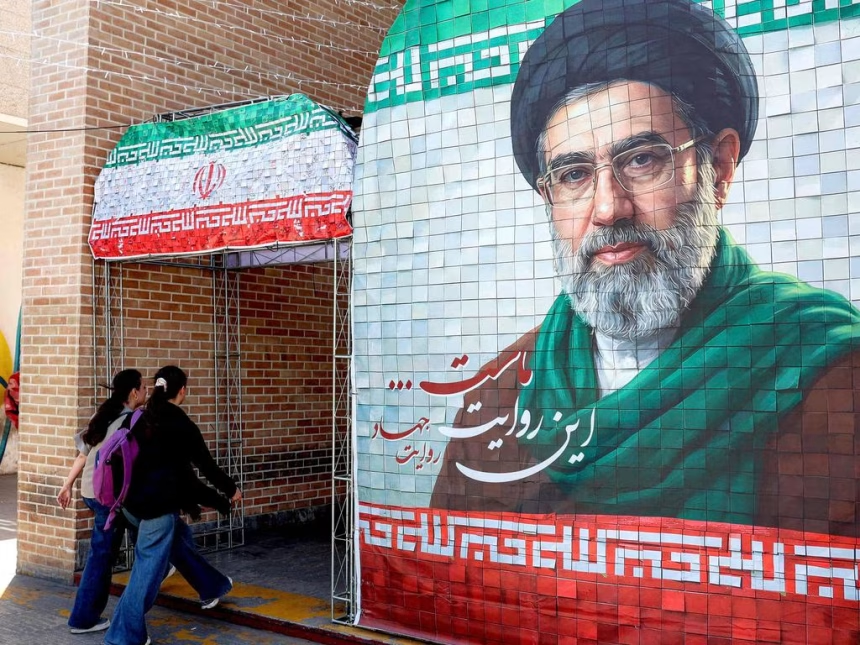
Iranian President Masoud Pezeshkian disclosed on Thursday that he had met with Supreme Leader Mojtaba Khamenei, who has largely remained out of public view since assuming office in March.
“What struck me most during this meeting was the vision and the humble and sincere approach of the supreme leader of the Islamic revolution,” Pezeshkian said in remarks broadcast on state television.
Meanwhile, tensions also remain high in Lebanon, where Israel carried out an airstrike on Beirut’s southern suburbs on Wednesday, killing a senior commander of Hezbollah’s Radwan force.
Israeli Prime Minister Benjamin Netanyahu defended the strike in a video statement.
“I say to our enemies in the clearest possible terms: no terrorist is immune. Anyone who threatens the State of Israel will die because of his actions,” Netanyahu stated.
The Israeli military also reported that four soldiers were wounded, including one seriously, following what it described as an “explosive drone impact” in southern Lebanon on Wednesday.