
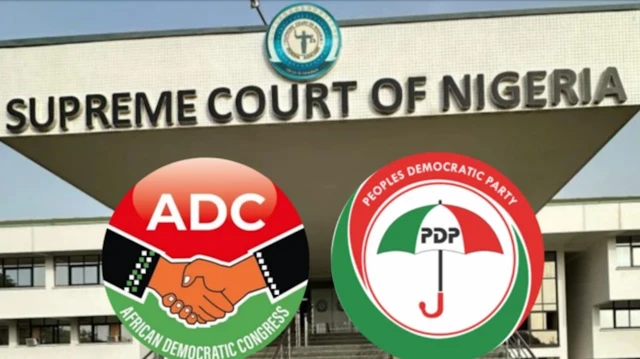
Nigeria’s Supreme Court of Nigeria is set to deliver judgment in two high-profile political cases involving the African Democratic Congress (ADC) and the Peoples Democratic Party (PDP), with outcomes expected to significantly influence the country’s opposition dynamics ahead of the 2027 general elections.
At the core of both cases are critical legal questions regarding the extent of judicial intervention in party affairs and the legitimacy of competing leadership factions.
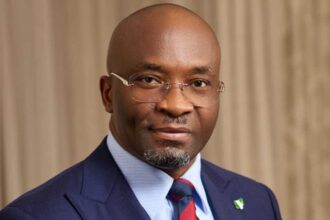
In the ADC case, former Senate President David Mark is seeking to overturn earlier rulings that allowed a suit challenging the party’s leadership structure to proceed.
His counsel, Jibrin Okutepa (SAN), argued that courts lack jurisdiction over internal party disputes, referencing a March 21, 2025, decision of the apex court which held that such matters fall outside judicial authority.
However, counsel to Nafiu Gombe, Robert Emukpero (SAN), opposed the appeal, insisting it lacks merit and that the lower courts acted within the law.
The Court of Appeal had earlier dismissed Mark’s application as premature and ordered the matter to return to trial, directing all parties to maintain the status quo ante bellum.
Following that ruling, the Independent National Electoral Commission (INEC) withdrew recognition of the Mark-led leadership pending final judicial determination.
Dissatisfied with the outcome, Mark approached the Supreme Court, also challenging the order enforcing the status quo.
PDP Convention Crisis
In a parallel case, the apex court will rule on a leadership crisis within the PDP arising from its disputed national convention held in Ibadan, Oyo State.
The appeal was filed by a faction led by Taminu Turaki, seeking to overturn a Court of Appeal judgment that nullified the convention over alleged violation of a subsisting court order.
Through counsel Paul Erokoro (SAN), the appellants urged the court to validate the convention and dismiss a cross-appeal filed by a rival faction aligned with the Minister of the Federal Capital Territory, Nyesom Wike.
Respondents, including former Jigawa State Governor Sule Lamido, argued that the issue transcends internal party affairs, stressing that it involves disobedience to a valid court directive.
Lamido had secured a Federal High Court order restraining the PDP from conducting the convention until he was allowed to contest for the position of national chairman.
Despite the order, the convention proceeded—an action later declared unlawful by both the trial court and the appellate court, which held that the matter was not protected under the doctrine of internal party affairs.
The Supreme Court’s rulings are expected to provide clarity on the legal boundaries of party autonomy and judicial oversight, while potentially redefining leadership structures within both parties ahead of the next electoral cycle.