


The Katsina State Government has taken delivery of fifteen newly procured, state-of-the-art intensive care emergency ambulances as part of efforts to commence round-the-clock emergency healthcare services across the state.
The ambulances, which will be strategically stationed along major highways, in densely populated areas, and within communities, are aimed at ensuring rapid response to medical emergencies, accidents, and disasters. The development marks another milestone in the ongoing transformation of the state’s healthcare sector.
Each ambulance is fully equipped with modern life-support systems, oxygen units, patient monitors, stretchers, and essential resuscitation equipment, enabling them to handle critical cases and stabilize patients while in transit to health facilities.
While witnessing the offloading of the ambulances on Monday at the New Katsina Government House, Governor Dikko Radda, represented by the Chief of Staff, Abdulkadir Nasir, described the arrival of the vehicles as a significant achievement in governance.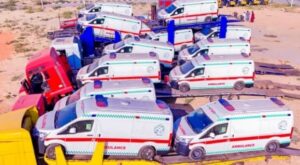
He noted that with ongoing construction of new roads and rehabilitation of existing ones across the state, vehicular movement is expected to increase, alongside the risk of road accidents.
“With a simple emergency call, an ambulance should be able to arrive within minutes to convey victims to the nearest health facility,” he said, adding that government must be fully prepared to respond as traffic volume rises.
“These units are not just vehicles; they are mobile intensive-care units designed to save lives at the most critical moments. No citizen of Katsina State should lose their life simply because help could not arrive in time,” he emphasized.
The Chief of Staff explained that the current administration is deliberately investing in high-quality, fully equipped ambulances to strengthen emergency healthcare delivery, reduce preventable deaths, and ease pressure on secondary and tertiary health facilities.
“Our goal is simple — faster response, better care, and a healthier Katsina State,” he said, stressing that the initiative is people-centered and designed to serve both urban and rural communities.
He further disclosed that a coordinated management framework will be established in collaboration with the Federal Road Safety Corps (FRSC), the Ministry of Health, and relevant local government authorities to ensure effective deployment and supervision of the ambulances.
According to him, the ambulances will be deployed in phases across the three senatorial zones and major healthcare facilities in the state to guarantee wide coverage and maximum impact.