
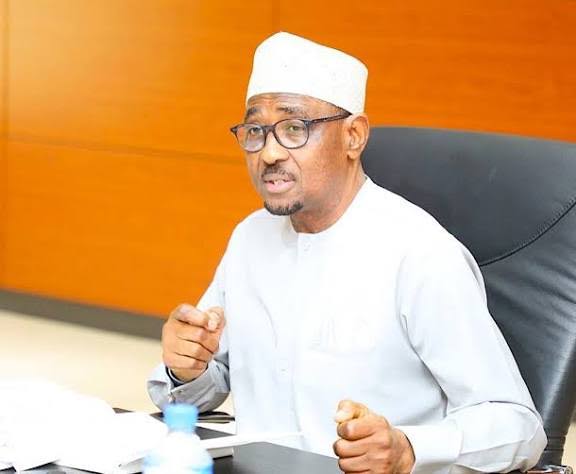
The Chief Executive Officer of the Nigerian Midstream and Downstream Petroleum Regulatory Authority (NMDPRA), Engr. Farouk Ahmed, has rejected corruption allegations levelled against him by the President of the Dangote Group, Aliko Dangote, describing the claims as “wild and spurious.”
In a personally signed disclaimer, Ahmed denied issuing any public response to the allegations and said he would refrain from engaging in a public exchange, opting instead to defend himself before a formal investigative body.
“My attention has been drawn to a purported response I was said to have made on the recent allegations against my person.
I hereby state categorically that the so-called statement did not emanate from me,” Ahmed said.
He added that while he was aware of the allegations and the public reaction they had generated, he would not engage in what he described as a media confrontation.
“While I am aware of the wild and spurious allegations made against me and my family and the frenzy it has generated, as a regulator of a sensitive industry, I have opted not to engage in public brickbat.
Thankfully, the person behind the allegations has taken it to a formal investigative institution. I believe that would provide an opportunity to dispassionately distill the issues and to clear my name.”
Background to the Dispute
The allegations stem from a long-running dispute between the NMDPRA and the Dangote Group over Nigeria’s downstream petroleum sector.
On Sunday, Dangote accused Ahmed of economic sabotage, alleging that regulatory actions by the NMDPRA were undermining domestic refining efforts in Nigeria.
The disagreement dates back to July 2024, when Ahmed reportedly stated that products from local refineries, including the Dangote Refinery, were inferior to imported petroleum products. Dangote publicly rejected the claim, conducting a diesel quality test during an oversight visit by federal lawmakers to his refinery.
ICPC Petition and Allegations
More than a year later, Dangote formally petitioned the Independent Corrupt Practices and Other Related Offences Commission (ICPC), accusing Ahmed of corruption and living beyond his legitimate means.
At a press briefing at the Dangote Refinery in the Ibeju-Lekki area of Lagos State, Dangote alleged that Ahmed spent millions of dollars on the foreign education of his children.
“I’ve had people actually complaining about a regulator who put his children in secondary school, and that secondary school education, which is six years, four of them cost Nigeria five million dollars,” Dangote said.
“My children went to secondary school in Nigeria. They did not go outside Nigeria to attend secondary school.”
On Tuesday, Dangote published details of the allegations in a national daily and subsequently submitted a formal petition dated December 16 through his lawyer, Ogwu Onoja (SAN).
In the petition received by the ICPC Chairman, Musa Aliyu (SAN), Dangote accused the NMDPRA boss of spending over $7 million on the education of his four children in Switzerland without evidence of lawful income.
He listed the children, their schools, and the amounts allegedly paid for verification by the anti-graft agency.
Dangote further alleged that Ahmed used the instrumentality of the NMDPRA to divert public funds for personal benefit, actions he said had triggered protests by various groups.
“Nigerians deserve to know the source(s) of these sums of money paid by a public officer while many parents in his home state of Sokoto cannot afford to pay N10,000 school fees for their children and wards,” Dangote said.
The petition accused Ahmed of abuse of office, corrupt enrichment and breach of the Code of Conduct for public officers.
“It is without doubt that the above facts in relation to abuse of office, breach of Code of Conduct for public officers, corrupt enrichment, embezzlement are gross acts of corrupt practices for which your Commission is statutorily empowered to investigate and prosecute,” the petition read.
Dangote urged the ICPC to arrest, investigate and prosecute the NMDPRA chief if found culpable, insisting that accountability was critical to public trust and the integrity of regulatory oversight in Nigeria’s petroleum sector.
Ahmed, however, maintained that he would clear his name through due process rather than public debate.