
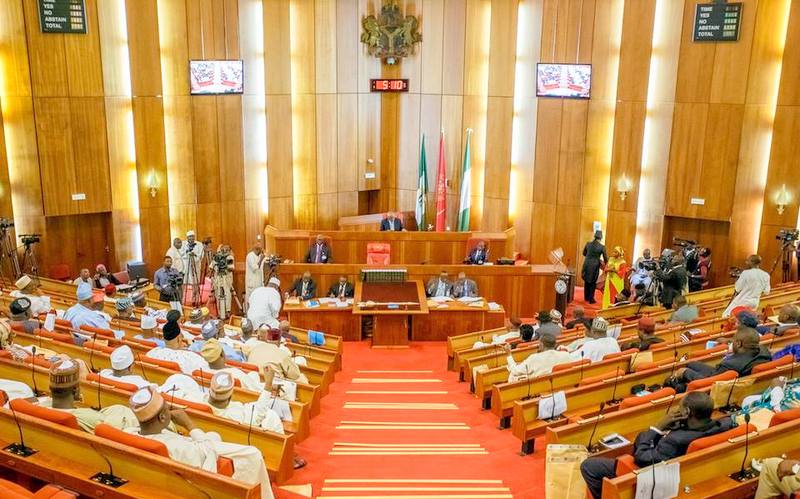
The Senate has resolved to establish a joint ad hoc committee with the House of Representatives to address the increasing cases of xenophobic attacks targeting Nigerians in South Africa.
The planned committee, to be headed by the leadership of the National Assembly, will embark on a fact-finding and diplomatic mission to South Africa as part of efforts to find a lasting resolution to the crisis.
As part of its assignment, the delegation is expected to engage directly with the South African Parliament, where it will formally communicate Nigeria’s strong displeasure over the reported incidents involving its citizens.
In addition, the Senate will write to the Speaker of the South African Parliament and invite the Minister of Foreign Affairs to brief lawmakers on diplomatic efforts and outcomes related to the situation.
The upper legislative chamber also adopted a motion sponsored by Senator Simon Bako Lalong, calling for a reassessment of agreements reached during the 2019 bilateral engagements between Nigeria and South Africa, with a focus on ensuring their full implementation.
During deliberations, Senator Adams Aliyu Oshiomhole proposed the withdrawal of operating licences of South African firms, including MTN and DSTV, in Nigeria. However, the proposal was ruled out on procedural grounds.
In his remarks, the Senate President emphasised the importance of diplomacy in resolving the issue, stating that economic retaliation against businesses would not be the preferred approach. He noted that the Senate considers the attacks serious and is committed to addressing them with urgency.
The resolutions followed a motion of urgent national importance raised by Senator Bassey, titled: “Intensifying Xenophobic Persecution of Nigerians in South Africa and Ghana: A Call for Urgent National, Diplomatic and Humanitarian Action to Defend the Dignity, Safety and Honour of Nigerian Citizens.”
Debate on the motion saw differing views among lawmakers. While Senator Adamu Aliero suggested that discussions be moved behind closed doors, Senator Abdul Ningi and others opposed the move, insisting on an open session.
Lawmakers voiced concern over not only the physical assaults but also the broader impact on Nigerians abroad, including fear, psychological distress, and what they described as increasing dehumanisation. They noted that many Nigerians are being singled out and targeted based on their nationality.
The Senate concluded its deliberation by observing a minute of silence in honour of Nigerians who have lost their lives in the attacks in South Africa, reaffirming its commitment to protecting citizens at home and abroad.